The Diversion Number Was Always a Guess Until Now
Twenty-five years in waste management taught me this: for most of that career, “zero waste” meant a banner on a loading dock and a spreadsheet nobody trusted. The industry standard sounds precise enough. An operation diverts 90% or more of a facility’s discarded material from landfill, verifies against benchmarks like UL 2799, and earns the Zero Waste label. The 90% figure hides how little visibility anyone actually had into the material stream generating that number. Operators knew what left the building. Operators rarely knew what actually sat inside the load, or why the recycling facility three counties away rejected it.
The measurement gap remains the real problem legacy waste systems never solved. Routes run on fixed calendars, not on what’s actually in the bins. Contamination surfaces downstream, after the truck burned the diesel and the hauler ate the tipping fee. Nobody measures the loop; everybody measures the endpoint. A 90% diversion rate calculated from a broken measurement chain isn’t a diversion rate. A guess wears a certification sticker.
AI changes what gets measured, and when it gets measured. The upgrade replaces a marketing layer bolted onto the same reactive system with sensing and decision infrastructure that turns collection into a working feedback loop. That argument holds up in places and breaks down in others, and the rest of this piece walks through both.
The Bin Talks Back Now
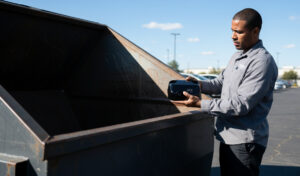
Start at the container, since the old system saw the least there. An unopened dumpster tells an operator nothing. RTS’ Pello smart sensors, now running at venues like Citi Field, measure fill volume and flag contamination in real time, before a truck ever gets dispatched. The upgrade sounds like a small thing, until you consider what it replaces. The upgrade marks the difference between a route built on a calendar and a route built on demand.
Strip away the logistics-speak, and fixed-route collection becomes an admission that nobody knows what sits in the bin. Sensor networks remove that excuse. A container holding 30% capacity needs no Tuesday pickup simply because Tuesday marks when the truck usually comes. A container showing contamination spikes needs an intervention — a liner swap, a signage change, a conversation with whoever’s throwing food waste into the recycling stream — well before the material reaches a facility that will reject the whole load.
Enterprise venues and large commercial properties were the obvious early adopters, because they run enough volume to make the sensor economics work immediately. Fewer unnecessary hauls. Fewer half-empty trucks burning fuel on a schedule instead of a signal. The intelligence layer sits upstream of the truck now, precisely where earlier systems missed it.
The Truck Already Knows What You Threw Away
Move downstream one stage, to the vehicle, where AI stopped acting as a bin-side convenience and started changing curbside behavior.
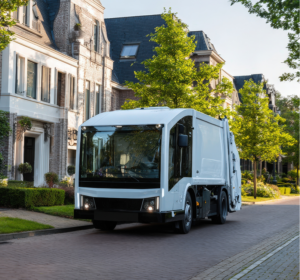
WM and The Recycling Partnership have deployed hopper-mounted cameras that identify contamination as material enters the truck, right at the point of collection. AMCS runs a comparable onboard vision system that logs contamination automatically and feeds the data back into haul routing. Prairie Robotics has taken the same underlying capability and directed the technology at residents directly, expanding camera-based education programs in cities including Tacoma, where a household that keeps bagging recyclables in plastic gets a targeted notice instead of a silent rejection three weeks later.
That closes a real gap, the feedback loop between the person putting material in the bin and the consequence of getting it wrong. Under the old system, contamination surfaced at the material recovery facility, attributed to nobody, correctable by nobody. Now it’s attributed to a specific address, a specific pickup, a specific bad habit, recorded the moment the hopper lifts the can. Education gets targeted instead of blasted to an entire zip code in a mailer nobody reads.
The logistics case is separate and, frankly, larger. A 2022 study in Waste Management, one of the field’s peer-reviewed journals, found AI-driven route optimization cutting municipal collection distances by nearly a third. A cut of that size, because fuel is one of the largest line items a hauler carries, shows up directly in the budget. Cut travel distance by more than a third, and a hauler cuts fuel burn, driver hours, and vehicle wear in the same motion. Those are the operating costs that decide whether a mid-market hauler survives the next fuel price cycle.
Sixty Items a Minute Was Never Going to Scale
Everything upstream of the material recovery facility works toward one outcome, cleaner material arriving there. The volume problem lives in what happens once that material arrives.
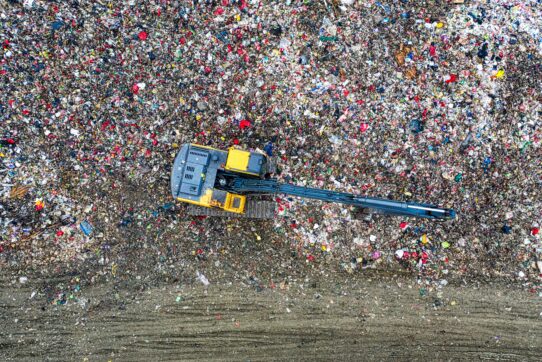
A trained human sorter, working a line, can pull roughly 60 items a minute. Tomra’s AI-driven optical sorting systems, now separating used beverage cans by material composition at high speed, and the deep-learning platforms Waste Connections has deployed with AMP Robotics operate in a different order of magnitude entirely (AMP Robotics cites throughput near 2,000 items a minute in its own published equipment specs). That’s not an incremental efficiency gain. That throughput marks a different category of operation, one where purity of the separated stream, not raw speed, becomes the binding constraint on what a facility sells.
Waste Connections isn’t treating this as an experiment, given the capital the company has already committed. On Waste Connections’ Q1 2026 earnings call, executives told analysts the company had allocated roughly $100 million in capital toward AI projects, aimed squarely at operating margin and resource recovery. Waste Connections is a company with decades of legacy infrastructure choosing to spend nine figures rewiring how material separates. Money moves toward what actually works; capital rarely moves toward a pilot program still proving itself.
High-purity separation always proved the hardest part of “zero waste” to fake. An operation diverts a ton of material from landfill and still fails the standard if the recovered stream turns out too contaminated to resell as PET, aluminum, or fiber. Optical sorting at machine speed brings the purity threshold within reach at the volumes a real city or a real commercial account actually generates.
Where the Robots Still Need Us
None of this is a fully solved problem; this industry has plenty of people who’d claim otherwise, and I’d distrust every one of them.
Vision systems, whether hopper-mounted or MRF-based, still depend on line of sight. A camera watching a conveyor belt misses what sits buried under three other items on a fast-moving line; occlusion remains a real limit, not a marketing footnote. I’d expect these systems to treat occlusion as a known constraint to design around rather than a disqualifying flaw, though none of the vendors cited here publish occlusion-handling specifics. Occlusion just means the purity numbers quoted in these reports are ceiling estimates under good conditions, not guarantees across every condition.
A distinction is also worth holding onto: everything described above manages waste. None of the technology described above prevents waste. Better sorting, smarter routing, and cleaner streams optimize what happens after the material already exists. Zero Waste, as a philosophy, starts further upstream, with the reduce-and-reuse habits that keep material out of any bin, smart or otherwise. AI didn’t touch that part of the equation, and it may never need to. The two problems are related but not the same one.
And there’s a capital problem underneath both. Rubicon’s Nate Morris made the case in a 2023 CNBC interview that technology lets independent haulers compete against the national consolidators. But sensor networks, vision cameras, and MRF automation all carry real capital expenditure, and a hauler running a few trucks in a mid-sized market lacks Waste Connections’ balance sheet. The technology is real. Access to it isn’t distributed evenly yet, since a hauler running a few trucks in a mid-sized market can’t self-fund the same buildout.
The Diversion Number Just Became Auditable
The real change sits underneath the individual technologies themselves, in the shift from an honor-system claim to one a third party can actually check. A 90% diversion claim used to rest on an honor system: self-reported tonnage, periodic audits, faith that the numbers held up between certifications. Sensor data, camera logs, and sorting throughput turn that claim into something continuously verifiable — a live number instead of an annual estimate.
RTS’s 2025 Sustainability Snapshot, the company’s published annual client-portfolio report, put diversion at 48,600 tons under TRUE Zero Waste standards, and that figure is only as credible as the measurement chain behind it. The measurement chain is the real stake here. Not whether AI makes recycling feel more futuristic. Whether the certification means what the label claims when someone checks.
AI, in my view, doesn’t get anyone to Zero Waste through AI alone. AI is the only thing that makes the claim auditable once an operation reaches that point.