PFAS and the Coming Landfill Cost Shock: Why Waste Diversion Is Now a Financial Decision
Twenty-five years in this industry produced more landfill engineering reviews than anyone bothered to count, and for most of them, leachate ranked as the dullest line on the agenda. Leachate got collected, trucked or piped to the local wastewater plant, treated alongside everything else, and nobody asked many questions. The hands-off era ended. PFAS turned a routine wastewater handoff into a legal and financial exposure that now reaches up the chain to the company putting a dumpster behind the building.
The subject here isn’t really chemistry, even though chemistry started the exposure. Cost drives the real story. This cost story raises a question that every commercial waste generator asks right now, because the money has to come from somewhere: who pays when the bill comes due?
The Free Ride Is Over
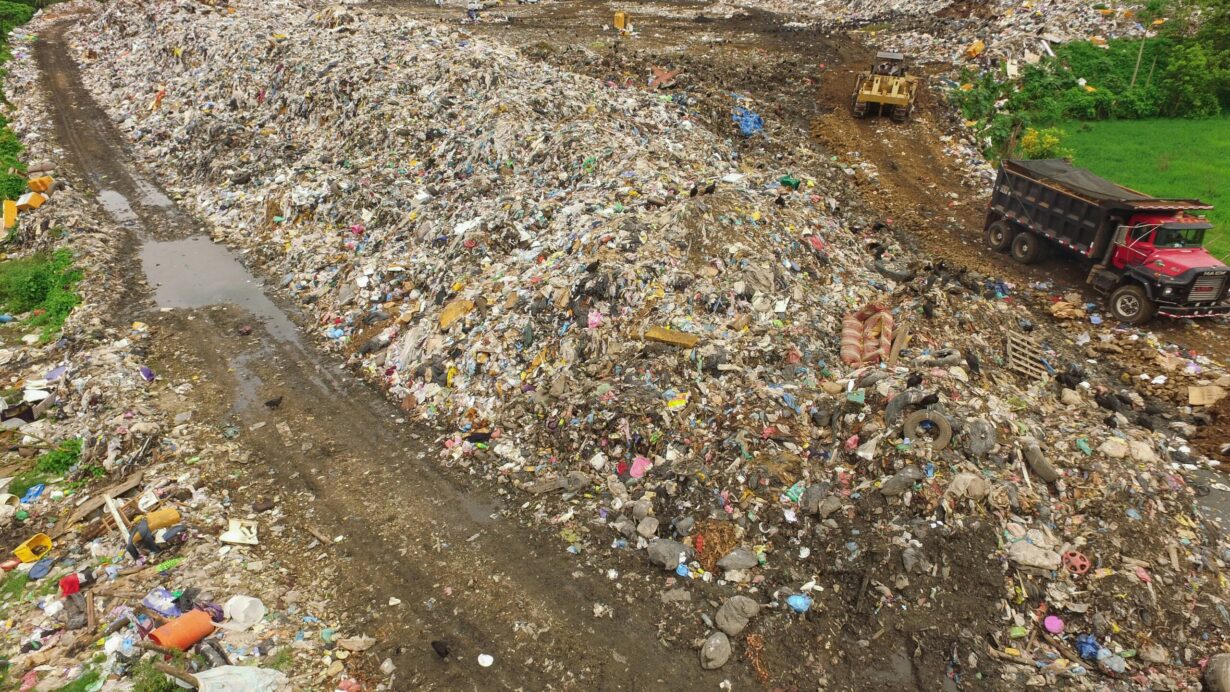
For decades, landfills functioned as passive receivers: material went in, leachate came out, and the liability stopped at the gate. That assumption drove pricing across the entire disposal chain (haulers set rates assuming disposal was a fixed, predictable cost, and generators never thought about it beyond the invoice). PFAS broke that model. Landfill leachate carries forever chemicals at concentrations wastewater treatment plants never anticipated, and the industry’s own trade press has tracked the fallout for years now, from engineering cost estimates to state-by-state crackdowns (Waste Dive).
Industry groups pushed hard for a “passive receiver” exemption, one shielding landfills from liability for PFAS they never generated, just stored. The passive-receiver exemption hasn’t held, despite industry pressure (Waste Dive). When EPA designated PFOA and PFOS as hazardous substances under CERCLA, it attached strict, joint-and-several liability to anyone in the chain of custody, landfill operators included (SL Environmental Law Group; American Bar Association). A landfill that simply accepted municipal solid waste in good faith now faces a Superfund cost-recovery action because of what showed up in the landfill’s own leachate years later. Most generators still miss this point: the exposure keeps climbing past the landfill gate now. It climbs the waste stream looking for a source.
Four Rules Closing In at Once
CERCLA closed one exit. The Clean Water Act is closing another exit, because discharge permits no longer stretch far enough to cover PFAS-laden leachate. POTWs closed a third on their own. RCRA is closing the last one.
EPA’s revisions to the Landfill Effluent Limitations Guidelines under 40 CFR Part 445 will require categorical on-site pretreatment for PFAS before leachate ever leaves the property line (U.S. EPA). That single change forces landfills to become water treatment facilities, not just dirt pits with a liner. Major operators and their trade associations objected loudly, warning regulators that the compliance burden exceeds what the current fee structure absorbs (Waste Dive).
Meanwhile, publicly owned treatment works have started closing their gates. Faced with strict new federal drinking water standards for PFAS, POTWs that once accepted landfill leachate without a second thought now reject or surcharge it, because they can’t risk failing their own discharge permits downstream (Waste Dive). A landfill that loses its wastewater outlet has exactly two options: build treatment on-site, or truck leachate somewhere that will take it, usually at a premium.
And RCRA is tightening from the other direction. EPA’s interim guidance on PFAS destruction and disposal explicitly discourages unmonitored land disposal of concentrated PFAS media, nudging the most contaminated streams toward incineration or deep-well injection instead of conventional Subtitle D landfills (U.S. EPA; Baker Donelson). The agency’s 2026 update to that guidance tightens it further, emphasizing destruction pathways over land disposal even as the science on what “destruction” actually means keeps evolving (Waste Dive). Add in recent survey data showing landfills release airborne PFAS through gas collection systems, not just liquid leachate, and you get a fourth regulatory front opening before the first three have even settled (Waste Dive).
None of this is theoretical. Minnesota already put multi-million-dollar remediation figures on the table for its own municipal landfills (Waste Dive), and Connecticut’s experience with a single contaminated site shows how fast a local cleanup balloons once groundwater tests confirm PFAS (Waste Dive).
What Compliance Actually Costs
Granular activated carbon, ion exchange, reverse osmosis, leachate evaporation: landfills now install these technologies to strip PFAS before leachate goes anywhere. Engineering estimates put the capital outlay in the millions per facility, with ongoing operating costs layered on top for media replacement, concentrate disposal, and monitoring (Waste Dive; LaBella Associates). Evaporation systems that concentrate PFAS for separate handling sound elegant on paper; in practice they require significant energy input and still leave operators with a hazardous residual to manage (Waste Dive; Waste Dive). None of it stays optional once a facility sits under a consent order, and none of it comes cheap.
So where does that money come from? Tipping fees. The Environmental Research and Education Foundation modeled the impact of PFAS leachate management on municipal solid waste disposal costs nationwide and landed on a 3% to 14% direct increase in tipping fees, depending on region and treatment pathway (EREF). This figure goes well beyond a rounding error; for a mid-size commercial generator paying six figures a year in disposal costs, the upper end of that range turns into a budget line that never existed two years ago.
This part concerns finance teams more than operations teams: haulers don’t absorb the cost. Analysts covering the major publicly traded waste companies turned blunt about it, describing federal PFAS regulation as a pricing opportunity, not a cost to quietly eat (William Blair). Landfill-owning haulers hold pricing power in markets with limited disposal capacity, and compliance costs give them fresh justification for environmental surcharges, minimum tonnage requirements, and contract terms that lock generators into disposal volumes regardless of what those generators actually produce. The regulation becomes the rationale; the generator’s invoice becomes the mechanism.
That exposure isn’t uniform. Markets in the Northeast and the Pacific, where disposal fees already run well above the national baseline because of land scarcity and permitting friction, will absorb the sharpest increases first. If your facilities sit in those regions, the EREF range I mentioned above is probably the optimistic end of your range, not the midpoint.
The Cheapest Ton Is the One You Never Send
The story shifts here, moving from regulation to arithmetic a business controls directly.
Wet waste is heavy, and heavy waste drives leachate volume. Food scraps and other high-moisture material sitting in a compactor generate the liquid that landfills now have to treat at rising per-gallon cost; every pound of organics diverted to composting or anaerobic digestion is a pound that never contributes to that volume, and it’s also a pound that stops counting against tonnage-based tipping fees and compactor overage charges. Businesses running food service, grocery, or hospitality operations sit on their single biggest lever, and most never pull it.
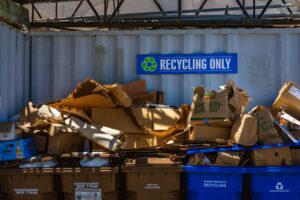
Packaging is the second lever. Corrugated cardboard and rigid plastics are high-volume, low-margin-to-dispose material when they go to landfill; the same material, separated and baled, becomes a commodity with a rebate attached instead of a fee. EPA’s own financial assessment of U.S. recycling infrastructure shows the system can absorb significantly more diverted commodity volume than it currently receives—which means the capacity to turn OCC and plastics into revenue isn’t the constraint (U.S. EPA). Generator habit is the constraint. States also started restricting PFAS in packaging directly, reshaping what materials show up in that stream over the next few years (Waste Dive).
The third lever is the one most companies skip because it sounds like overhead rather than savings: data. Fill-level sensors and bin monitoring tell you when a container is actually full, not when the schedule says to empty it. Businesses running fixed pickup schedules are routinely hauling air, paying full price for half-empty containers, because nobody measured. Right-sizing pickup frequency to actual fill rates eliminates that baseline pull charge entirely, and it does it without touching a single waste stream (organics or otherwise). Companies that have run this kind of audit consistently find more low-cost volume to cut than they expected going in (RTS; RTS).
Container size matters. Fill rate matters. Material composition matters. Pickup frequency matters. Every one of those is a variable a generator controls directly, independent of whatever EPA finalizes next year.
Building the Hedge
So what should a business start now, before the next rule becomes final?
Start with a real waste stream audit; not a glance at the invoice, but a physical characterization of what’s going into every container, isolating the high-moisture fraction and the recyclable fraction from everything else. Cutting what was never measured doesn’t work, and most commercial generators never actually look inside the dumpster sitting behind the building.
From there, track a small set of financial KPIs that most waste programs currently ignore: net cost per diverted ton—not just gross diversion rate, which can mask a program that costs more than the diversion saves—contamination rate in recycling streams (since contaminated loads get rejected and rebilled as disposal), and hauler surcharges as a percentage of base rate (the fastest-growing line item on most invoices right now, and the one finance teams notice last).
Then renegotiate the contract itself. Most hauling agreements fixed disposal as the baseline and treated diversion as the add-on; flip that structure. Decouple diversion gains from fixed disposal minimums, so that cutting tonnage actually shows up as savings instead of disappearing into a contractual floor the hauler wrote in before PFAS became anyone’s problem. A compliance review of the company’s own agreements against current waste regulation, not the regulation from five years ago, is worth the legal hour it costs (RTS).
Building this hedge requires no waiting for EPA to finalize anything. The rules land eventually, probably messier and later than the industry’s preferred timeline, and the companies still shipping full containers of wet, unseparated waste to landfill when that happens become the ones paying for cleanup costs they never generated. The companies that already cut tonnage pay a smaller bill on a smaller base. That’s the entire hedge. It isn’t complicated. It’s just early.