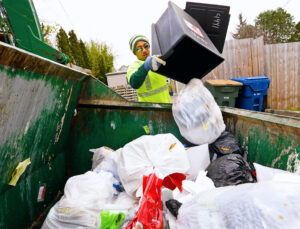
For most of the last century, waste management ran on a simple assumption: trucks show up whether the bin is full or not. Tuesday means Tuesday. A diesel truck idles at a dumpster that’s a third full, burns fuel, logs a stop, and moves on. Nobody upstream knew the bin was light. Nobody downstream cared. The whole system stayed blind by design; blindness counted as just the cost of doing business.
That assumption is now the expensive one.
Smart waste management has grown from a roughly $1.15 billion global niche, and the US segment alone now pushes past $4.2 billion; the growth isn’t coming from novelty (Mordor Intelligence; Market Research Future). It’s coming from auditors. ESG disclosure requirements, Scope 3 reporting mandates, and investors who want diversion numbers that survive a legal review have turned “we think we recycle a lot” into a liability. Waste Connections executives said as much in public earnings discussions: sustainability technology functions as a growth strategy now, not a marketing line item (WasteDive).
Replacing the old “show up anyway” model takes a full architecture, not a single piece of technology. Sensors capture container-level activity. Logistics software decides the next action. Processing facilities automate the sorting that used to depend on a person standing at a conveyor belt for eight hours. Enterprise platforms tie sensor data, logistics records, and processing metrics into something a CFO can actually audit. Peer-reviewed research on circular-economy frameworks describes the shift as one from linear disposal to closed-loop material intelligence, and the phrase fits (Frontiers in Sustainability).
Here are the ten technologies doing the work, organized the way material itself moves: generation, collection, recovery, and the data layer holding the system together.
First, Somebody Has to Know the Bin Is Full
Everything downstream depends on knowing what’s happening at the bin. For decades, that knowledge didn’t exist.
1. Multimodal AI Bin Sensors
Ultrasonic fill sensors go back years, and they never proved reliable enough to trust completely. Drop a flattened cardboard box into a dumpster and the sensor reads “full” when there’s still three feet of usable space underneath it. False fullness, that single failure mode, has quietly undermined an entire category of smart-bin technology.
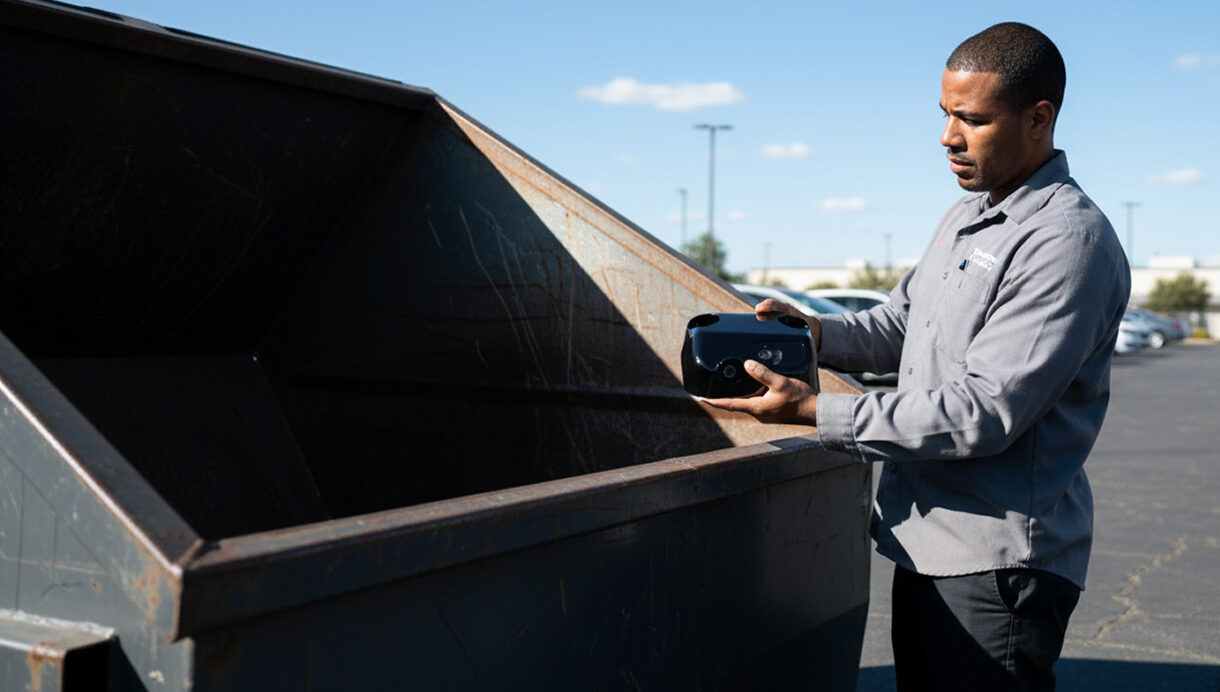
Pello, the sensor platform built by RTS, is designed, the company says, to stack sensing modes instead of leaning on one. It pairs dual ultrasonic depth sensors with multispectral optical cameras that can visually classify contamination, catching food waste tangled in a recycling stream or recyclables buried in general trash, and a three-axis accelerometer that tracks tip and service events in real time (RTS product specifications). The accelerometer detail matters more than it sounds: it means the system knows whether a container was actually emptied, not just whether a truck drove past it. Academic evaluations of sensor-based waste tracking have flagged exactly this gap between reported service and verified service as the weak point in earlier IoT deployments, and edge-computer-vision approaches are the fix researchers keep converging on (MDPI Sensors).
The deployment that made this concrete for me was Citi Field. RTS installed Pello sensors across the Mets’ home stadium to track fill levels in real time during game-day crowds, the kind of volume spike that can turn a normal bin into an overflowing one inside two innings; the team used the data to route hauler pickups before overflow happened instead of after (RTS, Citi Field case study). I’d call a stadium the most brutal testing ground imaginable: dense foot traffic, inconsistent material streams, and zero tolerance for a trash can visibly overflowing on television. If a sensor works there, it works in a loading dock.
2. Reverse Vending Machines and Deposit-Return Automation
Most sorting technology tries to clean up a mixed stream after the fact. Reverse vending machines skip that problem by never mixing the stream in the first place.
The consumer feeds a bottle or can into the machine. Barcode and geometric scanning verify the container type and confirm deposit eligibility on the spot, and the machine sorts it into the correct bin before it ever touches a recycling truck. Platforms like RTS’s Cycle system apply this logic to commercial and municipal deposit programs, producing a material stream that’s already deposit-grade (no contamination, no MRF cross-check required) because sorting happened at the moment of disposal, not three facilities later, according to RTS (RTS product overview).
It’s a clever inversion of how the industry usually solves sorting problems. Instead of building a faster robot at the end of the pipeline, move the decision to the person holding the bottle.
3. Smart Solar-Powered Compactors
Compaction ranks as the least glamorous item on this list, and it remains one of the most cost-effective. Solar-powered compactors mechanically crush waste on-site, multiplying effective bin capacity by four to five times. A container that used to need daily service can run for the better part of a week.
Cellular telemetry reports fill status to a dashboard, and that’s where the real operational gain shows up — municipalities running these units have documented collection-visit reductions of up to 80% in downtown corridors and parks (WasteDive). Fewer visits means less fuel, less crew time, and fewer trucks idling in traffic for a bin that didn’t need emptying. It’s not exotic technology. Crews are just now deploying it at scale.
Getting the Truck to Actually Change Course
Knowing what’s in a container only pays off if the truck actually changes course because of it.
4. Dynamic Routing and Predictive AI Fleet Dispatch
The old model routed trucks on a fixed calendar: same streets, same order, same day, every week, regardless of what was actually in the bins. Dynamic routing replaces the calendar with a graph-theoretic model that recalculates the optimal path using historical fill curves, live traffic, and vehicle weight limits.
The gains are not marginal. Research modeling AI-driven dynamic routing against static baselines has documented reductions in vehicle-kilometers-traveled in the 20–25% range, alongside corresponding drops in fleet carbon output (MDPI Sustainability; Frontiers in Energy Research). Market analysts tracking this specific niche now size AI-driven waste routing as its own growth category, separate from smart bins entirely (Research and Markets). That amounts to a meaningful signal: routing intelligence has matured enough for companies to sell, budget, and evaluate it on its own line item.
AI should not merely automate the existing route. It should redesign the route.
5. RFID Asset Tracking and Smart Bin Tagging
Billing disputes plagued commercial waste contracts for as long as those contracts existed. Was the container actually serviced? Was it full? Whose truck showed up, and when? Ultra-high-frequency RFID tags on commercial containers and roll-off boxes answer all three questions automatically, logging service events and verifying tare weight the moment a container is lifted.
Academic work on IoT-enabled solid waste monitoring identifies this kind of automatic verification as the difference between a system that reduces disputes and one that merely digitizes them (Emerald, Journal of Enterprise and Emerging Solutions). Field reporting on real IoT deployments backs this up — the technology pays off fastest where sensing, tagging and existing operational needs already line up, not where it’s bolted onto a workflow that wasn’t built for it (WasteDive).
6. Autonomous Heavy Refuse Vehicles and ADAS Systems
Refuse collection remains one of the most dangerous jobs in the country; BLS data has put the fatal injury rate for refuse and recyclable material collectors as high as 33 per 100,000 workers, consistently among the highest the agency tracks (BLS). That fact, more than any efficiency argument, is what convinces me autonomy research belongs on heavy refuse vehicles.
Computer-vision-guided Automated Side Loaders can now identify, align to, and lift a container without a worker stepping off the truck, and Knoxville, Tennessee has already piloted a drive-by-wire refuse truck on a controlled residential route (WasteDive). I don’t expect a fully driverless refuse truck downtown next year. ADAS-assisted collection removes workers from the highest-injury tasks (the lift, the backing maneuver, the curbside exposure) while a person still supervises the route; that combination reads as realistic, already-underway progress, not a driverless truck downtown.
What Happens Once the Truck Leaves?
Once material reaches a materials recovery facility, the bottleneck has always been the same: how fast can you separate a mixed stream into clean commodities?
7. High-Speed MRF Sorting Robotics
Manual sorting speed is often cited as roughly 30 to 40 picks per minute, a rough benchmark reflecting the limits of human reach and fatigue over an eight-hour shift rather than a precise measurement. Robotic sorting arms guided by computer vision models, YOLO-family object detection and convolutional neural networks trained on millions of labeled material images, are commonly reported to run at 80 to 120 picks per minute, sustained, shift after shift, though exact figures vary by vendor and material stream.
EverestLabs’ Navigator platform shows where this trend heads: instead of just picking, the AI agent monitors the entire sorting line, flags contamination patterns, and adjusts robotic arm behavior in near real time based on material actually crossing the belt (WasteDive). The robot isn’t replacing the sorter’s hands anymore. It replaces the sorter’s judgment about what comes next.
8. Optical Sorters and Hyperspectral Imaging
Vision-based robotic arms handle discrete objects well. They struggle with a fast-moving blur of mixed plastics and paper fiber on a belt running at 600 feet per minute. That’s where near-infrared spectrometry and hyperspectral imaging take over: reading the chemical signature of each material as it passes, then triggering a pneumatic air jet that diverts it into the correct stream, all without physical contact.
Systematic reviews of AI and IoT architectures across the municipal solid waste lifecycle point to this sensor layer as the piece that finally makes fully automated polymer separation viable at commercial belt speeds (NIH/PMC systematic review). A robotic arm decides what to do with a visible object. An optical sorter identifies material composition before a human eye registers the object passing by.
9. Anaerobic Digestion Digital Twins and Bio-Process SCADA
Not every waste stream ends up as a commodity bale. More and more, organic material, from food scraps to agricultural residue, goes into anaerobic digesters that convert it into renewable natural gas. The process runs on biology, which means it stays temperamental: pH swings, volatile fatty acid buildup and moisture imbalance sour a digester and stall gas output for days.
AI-driven monitoring systems now run as a digital twin of the digestion process, tracking those variables continuously and adjusting feedstock or mixing rates before a souring event happens rather than after. Optimization research on waste-to-energy systems frames this kind of predictive process control as the difference between digesters that hit their RNG output targets consistently and ones that chase them (Frontiers in Energy Research). It’s the least visible technology on this list. It’s also one of the few directly generating a saleable energy product instead of just moving material more efficiently.
Somebody Still Has to Answer to an Auditor
None of the previous nine technologies matter to a sustainability director if the data dies at the sensor.
10. Enterprise Data Platforms
This is the layer that turns nine separate technologies into one accountable system. Platforms like the RTS Portal are built, per RTS, to ingest Pello sensor feeds, hauler scale tickets, RFID service logs, and digester output data into a single digital twin of a company’s entire waste footprint. RTS has described this directly as applying supply-chain-style AI mapping to a category most companies never audited closely: their own trash (RTS).
The output isn’t a dashboard for its own sake. The output delivers audit-ready Scope 3 emissions reporting and diversion metrics that hold up when a sustainability claim faces a challenge, exactly the enterprise sustainability function RTS built its reporting protocols around (RTS sustainability services). It’s also why RTS’s 2023 acquisition of RecycleSmart Solutions, the company behind the original Pello sensor, amounted to a data-strategy move as much as a hardware one: folding the sensor layer directly into the reporting layer instead of leaving them as separate vendors (RTS; WasteDive; Recycling Product News).
The Future of Closed-Loop Resource Management
Container size matters. Fullness matters. Material type matters. Access conditions matter. For most of this industry’s history, none of that information reached the people making decisions about it; it just got hauled away.
What these ten technologies share is a refusal to accept that gap. Sensors replace guesswork at the bin. Routing software replaces the fixed calendar. Robots and spectrometers replace the limits of a human sorting shift. Enterprise platforms replace “trust us” with a number that survives an audit. The fuel savings, the diversion gains, and the injury reductions are real; the research cited above documents all three. But the underlying shift is bigger than any single metric.
Waste stopped serving as something you throw away and started counting as something you manage. The shift isn’t a slogan. It’s just where the data already points.