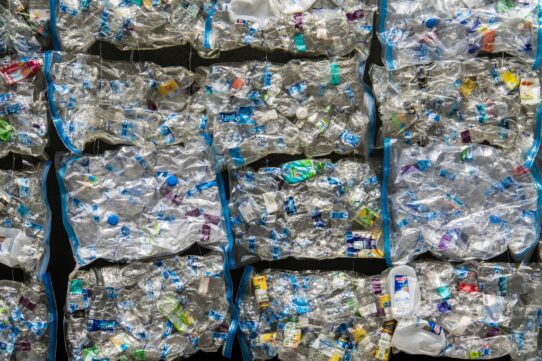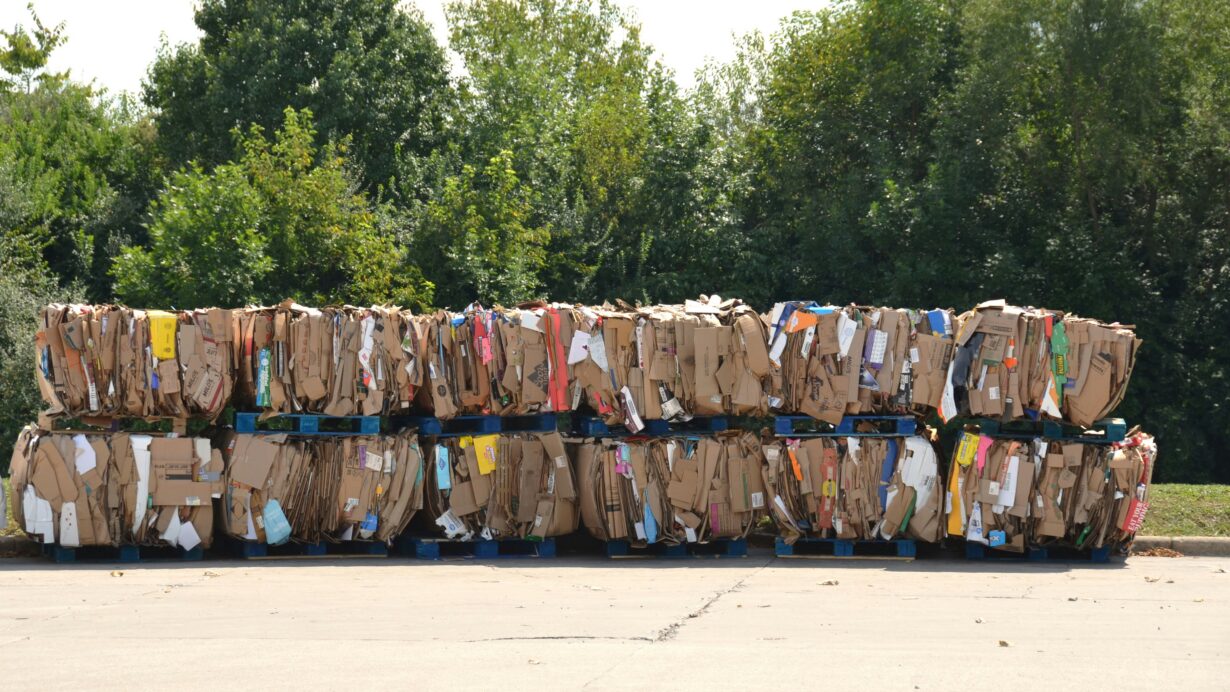
For years, trucks collected, sort lines guessed, and whatever China took ended up baled and shipped. Then in 2018 China stopped taking it. National Sword closed the door on the export market that American recycling quietly depended on, and the system never fully recovered. National diversion rates have sat in the low-to-mid 30s for years, stuck exactly where they were when the policy hit, according to the state-of-recycling data RTS compiles annually.
None of that stagnation is a mystery. Labor is short at material recovery facilities, and the work is dangerous and repetitive enough that turnover among human sorters runs high. Contamination keeps rising as packaging gets more complex. And now lithium-ion batteries tucked into dead vapes and cordless drills are starting fires on conveyor belts, a hazard serious enough that haulers are installing AI vision systems just to spot batteries before they ignite. Extended Producer Responsibility laws are arriving state by state, pushing brands to pay for the packaging those same brands sell. The old model wasn’t built for labor shortages, rising contamination, battery fires, or EPR mandates.
No better truck or better bin replaces the old model. Intelligence now layers onto infrastructure that had none. Sensors that read what sits inside a dumpster before a driver shows up. Cameras that spot a resin type in milliseconds. Robots that never tire, never contaminate, and never get hurt. Molecular processes that rebuild plastic instead of just melting the polymer. Recycling is leaving the civic-sanitation business and entering materials manufacturing, and these ten companies are the ones actually building that transition.
1. Recycle Track Systems (RTS)
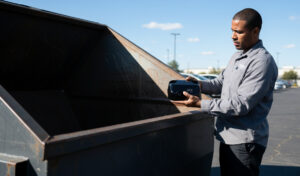
RTS started as a hauler in New York — which matters, because it means the technology got built by people who had actually ridden the trucks. Its Pello sensors sit inside dumpsters and compactors, tracking fullness, tilt and even temperature, then feed that data into routing software that cuts empty miles out of collection routes (RTS smart-bin technology overview). No more trucks rolling up to a half-empty container on a fixed Tuesday schedule.
The company also built Cycle, a reverse vending machine that pays consumers for bottles and cans at high-traffic venues like stadiums and campuses (RTS Cycle product page). That’s the consumer-facing bookend to a backend built on data; RTS has raised more than $40 million to scale both sides of it across North America (RTS financing announcement). The pitch to clients skips “we haul your trash.” It delivers verifiable diversion data clean enough to put in an ESG report (RTS on sensor-driven ESG reporting).
2. AMP Robotics
AMP (recently rebranded AMP Robotics) is the company that proved a camera could out-sort a person. Its systems use deep neural networks trained on millions of images of packaging to identify material type, polymer grade, and even brand, then direct robotic arms to pick at speeds no human sorting line sustains for an eight-hour shift. Founder Matanya Horowitz has argued for years that the economics of a material recovery facility change completely once vision replaces guesswork (Horowitz op-ed on AI and MRF economics).
AMP One, the company’s fully automated facility concept, pushes further: a plant designed around robotic sortation from the start rather than retrofitted onto a human line. Waste Connections, one of the largest haulers in North America, partnered with AMP to build exactly this kind of automated MRF in Colorado (Waste Connections–AMP automation partnership), and the company has since expanded into manufacturing its own sorting hardware at scale (AMP’s Colorado manufacturing expansion). A 2024 leadership transition to CEO Tim Stuart signaled a shift from proving the technology to scaling the business (AMP CEO transition).
3. Glacier
Glacier took a different bet: instead of building a full automated plant, retrofit the compact delta robots directly onto existing sorting lines at a fraction of the capital cost. Amazon’s Climate Pledge Fund backed the approach early (Amazon investment in Glacier), and a later $16 million Series A funded deployments at Recology’s Seattle operations (Glacier Series A and Recology deployment).
What makes Glacier worth watching isn’t just the robot arm; it’s the edge vision sensors recording item-level data on every piece of material that passes a given line. That telemetry let Amazon publish actual packaging-diversion metrics instead of modeled estimates (Amazon’s Glacier-sourced diversion metrics). Glacier has also shown up in broader capital-upgrade waves at national haulers chasing EPR compliance (MRF upgrades across Waste Connections, Glacier, WM, and Apex). Small robot, large dataset. Glacier makes that trade.
4. EverestLabs
EverestLabs treats the conveyor belt itself as the product. Its robotic sortation hardware runs underneath Navigator, a multi-agent AI platform that coordinates robots, cameras, and facility operations as one system rather than a collection of separate machines (EverestLabs’ Navigator rollout). The company has deployed across major operators including Rumpke, and it struck a notable partnership with the Can Manufacturers Institute and Caglia Environmental to capture more aluminum specifically, with profit-sharing tied to recovery volume (CMI–Caglia–EverestLabs aluminum partnership).
Sit with that deal for a second. A materials-industry trade group is now paying a software company to recover more of a specific commodity. This arrangement stops being waste management. It operates as supply-chain procurement wearing a recycling badge.
5. Redwood Materials
Founded by former Tesla CTO JB Straubel, Redwood runs recovery rates (by its own published figures) north of 95% on nickel, cobalt and lithium pulled from a dead EV battery — feeding the output directly into cathode active material for new cells. The company doesn’t stop at scrap from automakers; it partnered with Lime to collect and refine the batteries inside dead e-scooters and e-bikes (Redwood–Lime micromobility battery partnership), a stream nobody was systematically capturing before.
A decade ago, the batteries themselves posed the fire risk that made recovery this difficult. A pack “dead” to a scooter still holds enough charge to ignite. Redwood built logistics and processing to manage that danger, not avoid it, and the broader lithium-ion recycling sector it helped pioneer now runs through facilities designed for exactly this volatility (lithium-ion recycling market expansion).
6. Ascend Elements
Ascend skips a step most hydrometallurgical recyclers don’t. Instead of breaking black mass down into individual elements and rebuilding cathode material from scratch, its patented Hydro-to-Cathode process converts black mass directly into engineered precursor, cutting cost and energy use in the same motion. Honda signed a supplier agreement for recycled cathode active material built on exactly that process (Ascend–Honda supplier agreement) — a sign of where this is headed: automakers no longer treat recycled battery material as a sustainability footnote. They treat it as supply.
That matters because this sector never offered an easy ride for anyone. International Recycling Group had to cancel a planned Erie facility after a Department of Energy loan fell through (ERG Erie project cancellation), and federal loan guarantees for the whole battery-recycling category have wobbled under shifting policy (lithium-ion recycler loan guarantee dynamics). Ascend built its supply agreements first and its capital expansion second. My read: that sequencing is why it still stands.
7. Carbios
Mechanical recycling melts plastic, and every melt degrades the polymer chain a little further; most PET can only survive a handful of cycles before it’s downcycled into carpet fiber or filling. Carbios does something closer to digestion than melting. Its engineered enzymes break PET down into its base monomers at low temperature, and those monomers rebuild into virgin-grade plastic with no memory of having been a bottle, a tray, or a polyester shirt. Academic work out of Berkeley and GoogleX chased similar enzymatic breakthroughs (enzymatic PET and PLA research), and the broader bio-recycling field now stretches far enough to depolymerize blended synthetic textiles, not just clean bottle-grade plastic (enzymatic bio-recycling of PET and blended textiles).
The industry calls this advanced or chemical recycling, and the label gets dangerous fast; I’ll come back to why in a moment.
8. PureCycle Technologies
Polypropylene, the plastic in yogurt cups and bottle caps and most of the gray stuff nobody bothers recycling, has historically had nowhere good to go. PureCycle’s solvent-based purification process strips contaminants, odor and color from post-consumer PP without ever melting it, producing resin close enough to virgin material that brands will actually use it in new products. Waste hauler Rumpke signed on to feed the Ironton, Ohio plant directly (Rumpke–PureCycle supply agreement), and the company has announced global ambitions north of a billion pounds of annual capacity across Thailand, Belgium, and Georgia (PureCycle global capacity targets).
Ambition and execution aren’t the same thing, though. Ironton has gone through commissioning setbacks and a resin-sales slowdown serious enough to show up in quarterly earnings (PureCycle Ironton commissioning challenges). First-of-a-kind chemical plants are brutal to start up. Ironton proved that the hard way, one delayed quarter at a time.
9. Refiberd
Textiles rank among the hardest material streams in all of recycling, because a single garment often blends cotton, polyester, elastane, and dye together, and no sorter, human or machine, distinguishes those fibers by eye alone. Refiberd uses hyperspectral imaging, essentially reading the chemical fingerprint of a fabric rather than its color or shape, to identify fiber blends at the speed a sorting line demands. Refiberd’s hyperspectral imaging fits exactly what the wave of state-level textile EPR laws now landing in California and New York demands — laws that require clothing brands to disclose the actual fiber content of garments (state textile EPR momentum).
Refiberd’s technology has already been paired with WM and Goodwill to solve fiber identification for EPR compliance (AI-driven hyperspectral textile sorting deployments), and it sits alongside a broader wave of blend-characterization and depolymerization innovation reshaping the category (2026 textile recycling innovation survey). Evrnu’s earlier partnership with Levi Strauss on post-consumer denim already proved the demand existed (Evrnu–Levi Strauss circular denim). Refiberd is building the identification layer that makes it scalable instead of boutique.
10. TerraCycle
TerraCycle skips sorting altogether and builds a waste stream from nothing. Cigarette butts, chip bags, used razors, coffee pods, nothing on a curbside list goes anywhere near a municipal MRF, because none of it is economical to sort at that scale. TerraCycle’s answer is reverse logistics: brand-funded mail-back and drop-off programs that route a specific waste type directly to a processing method built for it, often cryogenic grinding that freezes multi-material packaging brittle enough to separate cleanly (TerraCycle program overview).
It’s a strange business model: convincing companies to pay for the privilege of taking back the packaging they sold. But TerraCycle’s approach alone worked for the genuinely unrecyclable, the stuff every other company on this list rejects at the tipping floor before a single sensor fires.
Where This Still Breaks
I don’t want to leave the impression that any of this is easy or finished. Capital expenditure plays the recurring villain in every one of these stories; first-of-a-kind plants blow budgets and timelines, loan guarantees vanish, and projects like ERG’s Erie facility end in outright cancellation. The technology isn’t what failed here. The pattern signals that financing still lags behind the engineering.
There’s also a credibility problem baked into the term “chemical recycling” itself. Carbios and PureCycle use genuine molecular processes, enzymatic depolymerization and solvent purification, that produce material indistinguishable from virgin resin. But the same label applies to pyrolysis operations that burn plastic into fuel and call it circular, a distinction advanced-recycling leaders argued over at length at the SERDC meeting last year (chemical recycling leaders debate at SERDC), and regulators still write the accounting rules meant to tell the two apart (emerging molecular recycling accounting standards). Burning plastic for fuel is not recycling. Call it what it is.
And none of this fixes the oldest problem in the industry: product design. A camera identifies seventeen layers of mixed-material packaging in milliseconds; the same camera still fails to separate those layers. The most sophisticated sorting robot on earth cannot out-engineer a yogurt cup designed by someone who never had to think about where the cup ends up.
The Shift Nobody’s Naming Yet
Every company on this list is quietly arguing the same thing: recycling stopped being a disposal service somewhere in the last five years, whether the public noticed or not. Recycling became a supply chain for materials that happen to already exist. Redwood isn’t managing battery waste; the company mines a battery supply that never has to leave the ground. PureCycle doesn’t process yogurt cups. It manufactures polypropylene resin that competes on spec sheet, not on guilt.
The old model never grasped this distinction: purity, not volume, drives the business now. The haulers who figure that out first win the next decade. The ones still measuring success in tons collected are going to find out, the way the export market did in 2018, that the floor can disappear fast.